How a Torsen differential works: interactive cutaway
Set each wheel's grip on a Torsen cutaway and watch the torque split change. See why the gears resist slip and what torque bias ratio really limits.
- Drawing
- DT-04.2
- System
- Drivetrain
- Stage
- Differential, 04 of 05
- Published
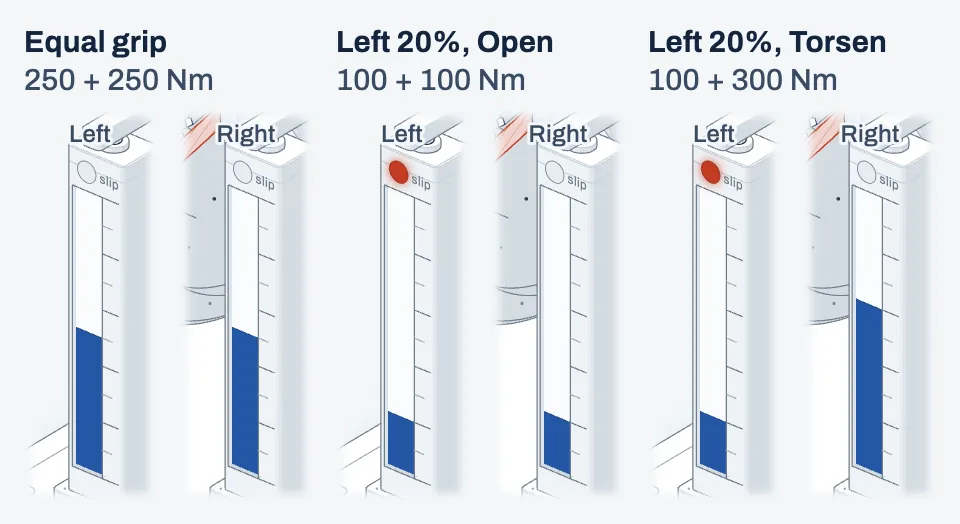
Cutaway of a Torsen T-1 differential on a bench rig. A pie-shaped slice of the housing and ring gear is cut away (cut faces in red) to show the two worms on the axle ends and two pairs of worm wheels whose spur gears mesh with each other. An input pinion drives the ring gear. Each axle ends in a brake drum clamped by a Prony brake whose drag stands for tire grip; its arm presses on a tall torque column in front, whose oil rises in a window to show that side's torque from 0 to 500 Nm, with a red lamp on top that lights while that wheel slips. Painted stripes on each drum show how fast it turns.
Torsen: the gripping wheel can take up to 3× the other's torque (example ratio, not a specification).
Torsen: L 150 Nm · R 350 Nm · 500 of 500 Nm delivered · no wheel slips
What is a Torsen differential?
A driven axle needs a differential so the outside wheel can turn faster than the inside wheel in a corner. A basic, or open, differential does that with a few bevel gears, and it always gives both wheels about the same torque. That is its weakness: a wheel on ice can hold only a little torque, so the wheel with grip gets the same little amount.
A Torsen keeps the corner-turning job and fixes the weakness with gears alone. The name is short for torque-sensing: it reacts to a difference in torque between the two sides, not to a difference in speed. The design goes back to the worm-gear differential Vernon Gleasman patented in 1958 (US Patent 2,859,641).
It works the same way between the two wheels of one axle or, as the center differential of an all-wheel-drive car, between the front and rear axles. Audi first used a Torsen center differential in the 80 quattro in the fall of 1986, with a 50:50 basic split.
How does a Torsen differential work, straight and in a turn?
The original Torsen, the Type 1 or T-1, is the one in the figure. Each axle ends in a worm, a gear shaped like a coarse screw. The housing carries worm wheels in pairs around the two worms, with their own axles crossed at right angles to the car’s axles. Each worm wheel meshes with only one of the two worms. The two wheels of a pair are tied together by small spur gears at their ends, one to one.

The engine’s torque turns the housing through the ring gear. Driving straight with equal grip, nothing inside spins on its own axis: the housing, the worm wheels and both worms turn together as one block. Give both wheels equal grip and each side gets half, 250 Nm in the figure.
In a turn, the outside wheel has to turn faster than the housing and the inside wheel slower by the same amount. Now the worms turn relative to the housing, the worm wheels spin on their own axes, and the spur gears carry the motion from one side to the other. The gears resist that motion a little, so under power a Torsen sends more of the torque to the slower inside wheel.
Why does a Torsen resist wheel slip?
A worm turns a worm wheel easily. Turning the worm from the wheel’s side is much harder. Whether it can happen at all depends on the worm’s lead angle, which is how steep its thread is, and on the friction between the teeth. When the friction angle is larger than the lead angle, the set will not drive backward. Gleasman’s patent used the lead angle to set how strongly the gears resist.
When one wheel starts to slip, its worm tries to spin its worm wheels faster. Through the spur gears, that motion would have to drive the worm wheels on the other side, and those would have to turn the other worm from the wheel’s side, which is the hard direction. So the slipping side is held back, and the torque goes to the wheel that can use it. Put the left wheel on a slippery patch and the right gauge climbs to three times the left. Switch to Open with the same grip and both sides drop to what the slipping wheel can hold.
It is not a solid lock, though many explanations describe one. Real units have a finite limit, the torque bias ratio, and the later T-2 type doesn’t use worms at all: it uses helical gears. The friction that does the work rises in proportion to the torque going through the gears, so the ratio stays about the same whether you are gentle or flat out on the throttle.
What is torque bias ratio (TBR)?
The torque bias ratio, or TBR, is the most torque the differential can send to the higher-grip side compared with the lower-grip side while it stays locked. A 3:1 ratio means one side can take up to three times the torque of the other, a 75/25 split. As long as the difference in grip stays inside that ratio, both wheels keep turning together. Past it, the differential lets the low-grip wheel spin.
That makes the ceiling easy to work out:
Most total torque = (1 + TBR) × the torque the low-grip wheel can hold.
An open differential gives both sides the same, so its ceiling is two times the low-grip wheel. These are upper limits: if the engine sends less, the wheels simply get what it sends. In the figure the input asks for 500 Nm, so with good grip on both sides the readout stops at 500. With an example ratio of 3:1 (an example, not a specification):
| Low-grip wheel can hold | Most an open differential can deliver | Most a 3:1 Torsen can deliver |
|---|---|---|
| 100 Nm | 200 Nm (100 + 100) | 400 Nm (100 + 300) |
| 50 Nm | 100 Nm | 200 Nm |
| 0 Nm | 0 Nm | 0 Nm |
A 4:1 unit can deliver about two and a half times as much as an open differential on the same surface.
Why can’t a Torsen help a wheel with no grip?
Look at the last row of the table. Three times nothing is still nothing. Set the left grip to zero and the total drops to zero, in Torsen mode as well as Open. This is the real limit of a Torsen: it multiplies the torque the weak side can hold, so it can never send all of the torque to one wheel.
Torsen vs open, clutch-type limited-slip and locking differentials
| Open | Torsen | Clutch-type limited-slip | |
|---|---|---|---|
| What sends more torque to the wheel with grip | Nothing: both sides get the same | Gear friction that rises with torque | Clutch plates pressed together |
| Resistance when no torque goes through (preload) | None | None | Usually |
| Clutch plates that wear | None | None | Yes |
A locking differential goes further: when it is locked, it ties both axles together so they turn at the same speed whatever the grip. A Torsen never does that. It biases torque up to its ratio and then lets the wheels turn at different speeds.
What are the T-1, T-2 and T-3 types, and is a Torsen 50/50?
| Type | Gears inside | What sets it apart |
|---|---|---|
| T-1 | Worms and worm wheels on crossed axes, as in the figure | The highest published bias of the three, roughly 3:1 to 4.5:1 depending on the application |
| T-2 | Pairs of helical gears that run parallel to the axles | Torque on the angled teeth pushes the gears’ ends against the housing, and that friction does the locking; bias set lower, about 2:1 to 2.5:1 |
| T-3 | A planetary gearset, built as a center differential | Its basic split is not 50:50 by design |
So a Torsen is 50/50 only if it is built that way. Audi’s first Torsen center differential was. A T-3 starts uneven on purpose, and that built-in split is a separate thing from its bias ratio. Uneven starting splits are common in center differentials: Audi’s self-locking center differential from 2005 starts at 40:60, front to rear.
What are the limits of a Torsen differential?
A Torsen can’t:
- Drive a wheel that has no grip. With one wheel in the air or on glare ice, a standard Torsen behaves like an open differential, because the ratio multiplies zero.
- Send all of the torque to one side. It can only multiply what the weak side holds.
On the plus side, little torque goes through it when you brake, so there is little bias then, and it does not get in the way of ABS.
One workaround is real: dragging the brake on the spinning wheel gives that side torque to hold, and the Torsen then multiplies it across to the other wheel. How much that helps varies from car to car.
FAQ
Is a Torsen a limited-slip differential?
Yes. The standard Torsen is a limited-slip differential that uses only gears, with no clutch plates and no preload.
Is quattro a Torsen or a Haldex?
It depends on the car. Audis with a lengthwise engine used a Torsen center differential from 1986, then a self-locking 40:60 unit from 2005, and from 2010 the RS 5 got a crown-gear center differential. Models with a sideways engine, such as the TT and A3, have used an electronically controlled multi-plate clutch since 1998, the system commonly called Haldex.
Is a Torsen differential a locker?
No. It holds the wheels together only while the grip difference stays inside its bias ratio, and it never joins them solid.
Sources (10)
- Torsen: How it works
- Torsen: Frequently asked questions
- R. Chocholek, Gleason Corporation: Torsen differential paper, IMechE C368/88 (1988)
- US Patent 2,859,641, Differential gear mechanism (V. E. Gleasman, 1958)
- US Patent 5,362,284, Three-stage torque proportioning differential
- Machine Design: Self-locking worm gears, fact or fiction?
- Audi Technology Portal: quattro
- Flash Off-Road: The Torsen in the Hummer
- Design Judges: Differential effects
- Wikipedia: Torsen
Where this part sits
Power runs from the engine to the wheels. This part sits at the differential stage.