How synchromesh works: a synchronizer you can shift
Press Shift on a synchronizer cutaway and watch the blocker ring hold the sleeve back until speeds match. Switch the ring off to see the clash it prevents.
- Drawing
- DT-02.1
- System
- Drivetrain
- Stage
- Transmission, 02 of 05
- Published
Cutaway of a single-cone, strut-type synchronizer on a test bench. A wedge of the sliding sleeve is cut away over one of the three struts (cut faces in red) to show the hub splines, the strut and the blocker ring, whose teeth face the sleeve, with the gear's dog teeth behind it. A shift fork on a rail moves the sleeve; a push gauge on the rail reads the shift force, and a flywheel stands for the gear side. In front stand a large dial that reads how many rpm apart gear and shaft turn, with a red pointer at the speed difference the bench was set to, four lamps under it for Synchronizing, Blocked, Engaged and Clash, and a board that shows the same teeth unrolled flat and enlarged five times, labeled left to right: gear dog teeth, blocker ring (with the strut in its notch) and sleeve. The drawing turns with the shaft: hub, sleeve and struts stand still and the gear turns at the speed difference.
Example values, not a specification · played at 1/20 speed
Blocked · 200 rpm apart · cone torque 2.6 N·m
What is synchromesh (a synchronizer), and why does a manual transmission need one?
A manual transmission needs a synchronizer because the gear you select and the shaft it joins turn at different speeds, and teeth that meet at different speeds grind.
In a modern manual gearbox every pair of forward gears stays in mesh all the time. The gears on the output shaft spin freely on bearings, and you choose one by locking it to the shaft with a sleeve that has teeth on its inside: a dog clutch.
The trouble is timing. When you press the clutch pedal, the engine is cut off, but the input shaft, the countershaft, the gears on them and the clutch disc keep spinning at the speed of the gear you just left. So the gear you want turns at a different speed than the output shaft, which turns with the wheels.
Before synchronizers, drivers matched the speeds by hand, by double clutching. A synchronizer adds two things to each dog clutch: a small cone clutch that rubs the speeds together, and a blocker ring that keeps the sleeve from engaging until they match.
Cadillac put its Synchro-Mesh gearbox into production in 1928, for the 1929 model year, and it synchronized only second and third gear. “Synchro-Mesh” was Cadillac’s name for it; the generic name is synchronizer.
Speed differences show up elsewhere in the drivetrain too. A Torsen differential lets the two wheels on an axle turn at different speeds while it shares torque between them.
What are the parts of a synchronizer?

The figure shows a single-cone, strut-type unit, a common layout in car gearboxes:
| Part | Turns with | What it does |
|---|---|---|
| Hub | The output shaft, splined to it | Carries the sleeve and has three slots for the struts |
| Sleeve | The shaft, sliding along the hub | Its inner teeth, with pointed ends, lock the gear to the shaft; a groove on its outside holds the shift fork |
| Struts, or keys (three) | The shaft | A ring spring pushes them into a shallow groove inside the sleeve, so the sleeve carries them along at the start of a shift |
| Blocker ring, also called a baulk ring or synchro ring | The shaft, but it can turn a few degrees on its own | Its grooved inner cone grips the gear; its pointed outer teeth block the sleeve; its three notches, a little wider than the struts, sit on the struts |
| Gear | Its own speed, on a needle bearing, until it is locked | Carries the cone the ring grips and the dog teeth the sleeve slides onto |
What is a synchronizer ring made of?
Most car synchronizer rings are forged brass. Steel rings are used where the loads are higher, and either metal can carry a friction layer of carbon or molybdenum.
How does a synchromesh unit work, step by step?
- Neutral. The sleeve sits in the middle of the hub. The gear spins freely.
- Pre-synchronization. You press the clutch and move the lever. The fork pushes the sleeve toward the gear, and the struts, caught in the sleeve’s groove, push the blocker ring onto the gear’s cone.
- Indexing. The ring touches the cone while the gear and the shaft still turn at different speeds. Friction drags the ring around until the edge of each notch hits its strut. Now the ring’s teeth sit out of line with the sleeve’s. Which way the ring turns depends on whether the gear is running faster or slower than the shaft.
- Blocked. The sleeve keeps moving, the struts drop out of its groove, and the pointed ends of the sleeve’s teeth land on the pointed ends of the ring’s teeth. The sleeve can’t go further. Its push now presses the ring hard onto the cone, and the friction brings the gear, and everything on the input side behind it, to the shaft’s speed.
- Unblocking. When the speeds are equal, the cone stops dragging. The sloped tooth ends turn the ring back a little, the teeth line up, and the sleeve slides through the ring’s teeth.
- Engaged. The sleeve reaches the gear’s dog teeth. Their pointed ends guide it in, and it slides on. The gear is now locked to the shaft. The teeth are cut with a slight back angle that helps keep the gearbox in gear under load.
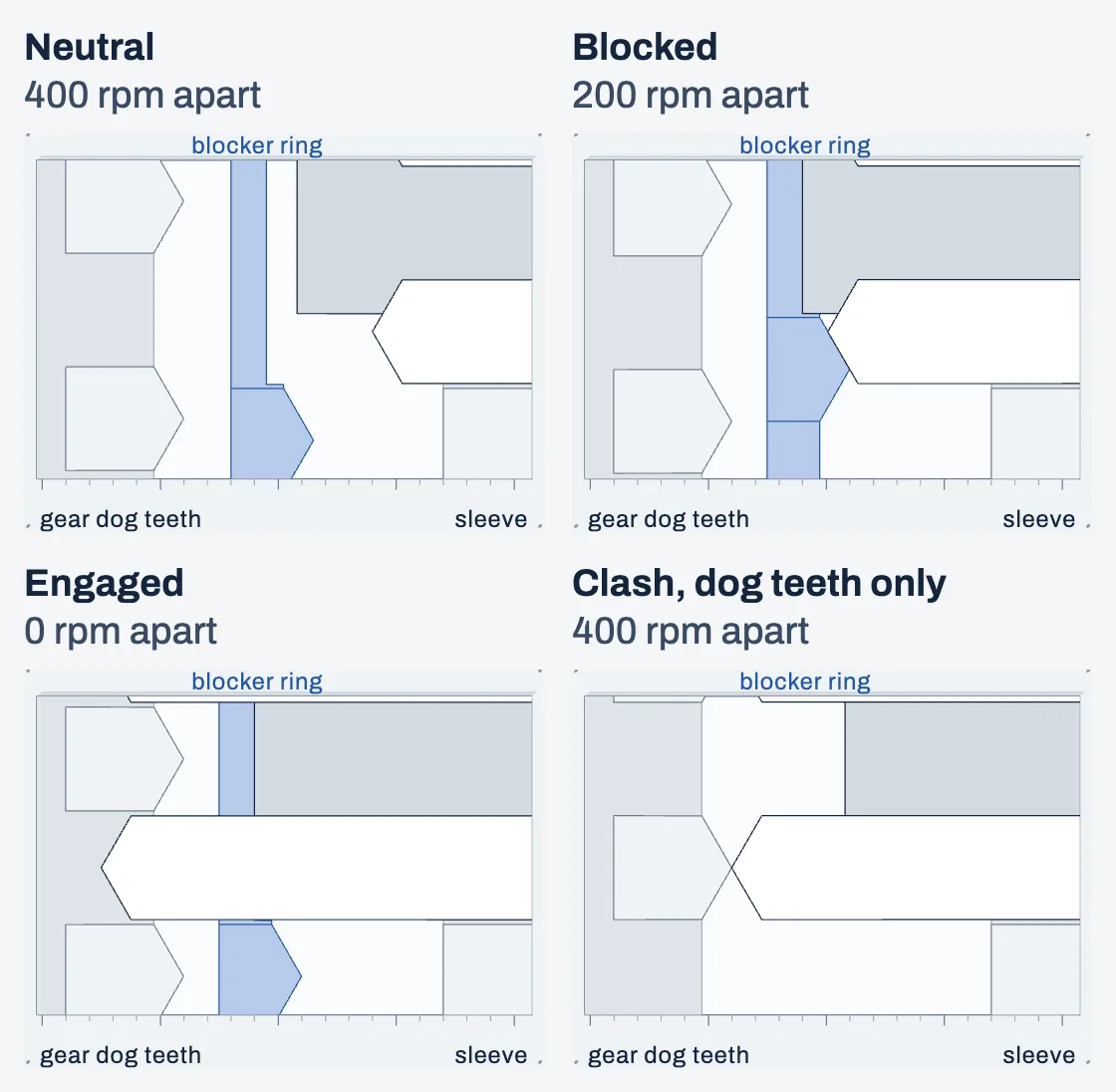
Watch one shift step by step. The board in front of the bench shows the teeth unrolled flat, so you can see the ring block the sleeve and then let it through.
What does the blocker ring do, and why can’t the sleeve slide on early?
The blocker ring holds the sleeve back because two twisting forces act on it. While the gear and shaft turn at different speeds, cone friction is the stronger one and keeps the ring’s teeth in the sleeve’s way. When the speeds match, that friction stops and the sloped tooth ends turn the ring back so the teeth line up.
The two forces:
- The cone’s friction tries to keep the ring turned against the struts, in the direction the gear is slipping.
- The sloped tooth ends act like a wedge. The sleeve’s push on them tries to turn the ring back so the teeth line up.
Engineers choose the cone size, the cone angle and the angle of the tooth ends so that this holds for as long as anything is slipping.
Both twists come from the same push on the shift lever. Push twice as hard and both double, so the ring still wins. A harder push makes the speeds match sooner, but it never opens the gate early. Shift with 60 N, then with 120 N, and compare the wait. The example below uses the figure’s model, with example dimensions (a 70 mm cone at 7 degrees, a friction coefficient of 0.10, an input side that has to change speed by 500 rpm, and an input-side inertia of about 0.01 kg·m²):
| Push on the sleeve (example) | Cone twist | Wedge twist | Ring | Time until speeds match |
|---|---|---|---|---|
| 60 N | 1.7 N·m | 1.2 N·m | holds | about 0.30 s |
| 100 N | 2.9 N·m | 2.0 N·m | holds | about 0.18 s |
| 120 N | 3.4 N·m | 2.4 N·m | holds | about 0.15 s |
These are example values, not a specification for any gearbox, and they leave out the oil drag inside a real gearbox.
When the speeds match, nothing slips anymore, so the cone’s friction stops twisting the ring. Only the wedge is left, and it turns the ring back. Shift with dog teeth only to see what the ring prevents: the sleeve’s teeth reach the dog teeth while they still turn at different speeds, and they clash.
Why is the cone so shallow?
A shallow cone grips harder for the same push, a little like a wedge driven into a hole. Synchronizer cones are typically about 7 to 7.5 degrees per side. Go too shallow and the ring sticks on the cone and won’t let go: with a friction coefficient of 0.10 that happens below about 5.7 degrees. That leaves a margin of about 1.3 to 1.8 degrees for manufacturing tolerances and wear. The fine grooves on the cone cut through the oil film so the friction can build quickly.
Why do gears still grind, and what does double clutching do?
Engineering studies of synchronizer failures name a short list of causes:
- The friction at the cone is too low, so the ring gives way before the speeds match.
- Wear lets the ring sit too far onto the cone, until it bottoms out against the gear and the cone can no longer grip.
- The sloped tooth ends wear and change their angle.
- A part breaks, such as the ring.
What you notice is grinding or crunching on a shift, a lever that is hard to move into gear, or a gearbox that pops out of gear. A clutch that doesn’t fully release can feel the same way: it keeps dragging on the input side, so the synchronizer has more to do. Grinding is not proof of a worn synchro.
Low gears work hardest because the speed change between them is largest and they have more rotating mass to match, so they are usually the first to complain. Downshifts are harder than upshifts: the synchronizer has to speed the input side up instead of letting it slow down. Try a downshift: the gear turns slower than the shaft, and the ring twists the other way.
Double clutching is the old way of matching speeds by hand: clutch in, shift to neutral, clutch out, raise or let the engine speed fall to suit the next gear, clutch in, select the gear, clutch out. With the clutch out in neutral, the engine itself brings the input side to the right speed. On a synchronized gearbox it is mostly unnecessary, though it can ease a downshift.
Synchromesh vs constant mesh vs sliding mesh
| Sliding mesh | Constant mesh with dog clutches | Synchromesh | |
|---|---|---|---|
| How a gear is selected | The gear slides along its shaft into mesh with its partner | All gears stay in mesh; a dog clutch locks one to the shaft | As constant mesh, with a cone clutch and blocker ring added to each dog clutch |
| Who matches the speeds | The driver | The driver | The synchronizer |
Reverse is often still a sliding gear without a synchronizer, which is why many cars need to be stopped before you select it. Some gearboxes do synchronize reverse.
What are single, double and triple cone synchronizers?
| Type | Friction surfaces | How it is built |
|---|---|---|
| Single cone | 1 | One blocker ring on the gear’s cone, as in the figure |
| Double cone | 2 | An outer ring, an intermediate ring and an inner ring |
| Triple cone | 3 | A third conical surface on the inner ring, against a cone on the gear |
More friction surfaces give more twisting force for the same push, so the speeds match faster or with a lighter lever. That matters most in the lower gears, where the speed change is largest, so first and second are the usual places for double and triple cones. The extra rings cost more and add drag.
FAQ
Does a synchronizer change the gear ratio?
No. The tooth counts of the gear pair set the ratio. The synchronizer only matches the speeds and locks the chosen gear to the shaft.
Does synchromesh match the engine’s speed?
No. With the clutch pedal down the engine is disconnected. The synchronizer brings the input shaft, the countershaft, the gears on them and the clutch disc to the right speed. Matching the engine’s speed with the throttle, rev matching, is the driver’s job.
Is reverse synchronized?
Usually not. Many gearboxes use a sliding reverse gear without a synchronizer, though some do synchronize it.
Do synchros wear out?
Yes. The ring and the cone are friction parts, so they wear with use. Worn synchronizers show up as grinding, stiff shifts or a gearbox that pops out of gear.
Sources (12)
- Stockinger, Schneider, Pflaum, Stahl: Influence of the number of friction surfaces on synchronizer behaviour (Forschung im Ingenieurwesen, 2020)
- Walker and Zhang, University of Technology Sydney: synchronizer modelling and parameter study
- Razzacki and Hottenstein: Synchronizer design and development for dual clutch transmission (SAE 2007-01-0114)
- US Patent 5,638,930, Strut-type synchronizer mechanism
- US Patent 5,097,930, Pin-type synchronizer
- US Patent 9,400,019, Friction ring for a synchronization unit
- x-engineer.org: How a synchronizer works
- TREMEC: Manual transmission synchronizers 101
- Diehl Metall: Synchronizer rings brochure (2020)
- Ate Up With Motor: Hydra-Matic history, part 1 (Earl Thompson and Synchro-Mesh)
- The Intercooler: Breakthrough, the synchromesh gearbox
- Jalopnik: Signs your synchronizers are failing
Where this part sits
Power runs from the engine to the wheels. This part sits at the transmission stage.